Welcome to the Civil Air Patrol 85th Anniversary Series. Each week leading up to CAP’s milestone anniversary on Dec. 1, we will be highlighting key operations and developments in the organization’s history, as depicted in this newly designed “Be a Part of the Story” historical timeline:

This is the second feature of the series based on the fourth and fifth tiles included in the timeline: “Becoming Civil Air Patrol: U.S. Air Force and its Auxiliary Tied Together from the Beginning.”
A series of congressional acts in the postwar 1940s set up a mutually beneficial relationship between a newly formed U.S. Air Force (USAF) and a newly incorporated Civil Air Patrol (CAP).
But it took the years during and after World War II to get there.
Early CAP volunteers flew coastal patrols, courier missions, aircraft warning, disaster relief, forest patrols, and missing aircraft searches during the war’s earliest years — officially forming Dec. 1, 1941, just six days before the Japanese attack on Pearl Harbor.
With its success in helping defend the homeland, the fledgling organization and its civilian force was transferred to the U.S. Army Air Forces in 1943. CAP's mission in the later years of the war was to partner with the military to patrol the homeland and provide various flight services to the Army, thereby freeing more active-duty pilots for combat duty.

On July 1, 1946, President Harry S. Truman signed Public Law 476 from the 79th Congress, which made Civil Air Patrol a federally chartered, nonprofit corporation. Observing the Oval Office signing was U.S. Army Air Forces Maj. Gen. Fred L. Anderson, standing left, and Army Air Forces Col. Earle L. Johnson, CAP’s national commander. Source: CAP National Headquarters.
On July 1, 1946, CAP was federally incorporated, chartered by congressional act, Public Law 476, as a nonprofit, benevolent organization devoted to aviation education and humanitarian activities. Its alignment with the Air Force would follow in 1947 when the National Security Act established the Air Force as a separate armed service and most air units and assets were transferred from the Army to the new Air Force.
By another act of Congress in May 1948, shortly after the creation of the Air Force, Public Law 557, made CAP the official auxiliary of the Air Force. This law authorized the Secretary of the Air Force to assign military and civilian personnel to liaison offices at all levels of CAP.
Maj. Gen. Regena M. Aye, CAP’s current national commander and CEO, reflected on those humble beginnings in advance of the organization’s 85th anniversary.
“The congressional charter and Air Force Auxiliary designation were historic milestones, but they are only meaningful because of the people who brought those responsibilities to life,” she said. “Every volunteer who has worn the uniform, mentored a cadet, completed a mission, or supported their community has added a chapter to CAP's story.”
Aye said CAP’s dual identity as a federally chartered nonprofit and the Air Force Auxiliary is unique.
“It allows us to leverage the passion and motivation of our volunteers while supporting critical national priorities and missions,” she said. “The combination of those roles is what makes us a force for good today.”

A Civil Air Patrol Cessna sits front and center among U.S. Air Force aircraft — a symbol of CAP’s support as a vital member of the Total Force — during a training activity in 2016 at Nellis Air Force Base, Nevada. Source: CAP National Headquarters.
The Air Force Auxiliary
CAP has truly evolved over the decades in both its missions and its relationship with its primary partner, the USAF.
“To me, being designated as the USAF Auxiliary is significant because it publicly recognizes the trust our Air Force has in us to serve alongside them in support of our nation,” Aye said.
“Being the Air Force Auxiliary formally established our lasting partnership that truly makes being a CAP member part of something much bigger than ourselves. It means service matters. Whether we are flying search and rescue missions, supporting disaster response, doing AE, building the next generation of leaders, or helping with homeland security, we are performing missions that benefit our nation. It is a privilege to do so, but it comes with the responsibility to be professional, ready, and trained when the call comes. While we are technically the USAF Auxiliary when doing Air Force missions, it is ingrained in who we are as an organization.”
That relationship with the Air Force took on new meaning in August 2015 when then Secretary of the Air Force Deborah Lee James and Air Force Chief of Staff Mark A. Welsh III updated USAF doctrine to effectively include CAP as a formal component of the Air Force, adding the civilian auxiliary alongside the active-duty Air Force, Air National Guard, and Air Force Reserve. Their actions officially recognized CAP’s volunteers as “Airmen” when conducting Air Force-assigned missions.

Secretary of the Air Force Deborah Lee James visits Maj. Gen. Joe Vazquez in front of CAP’s exhibit at the 2015 Air Force Association’s Air and Space Conference. During her visit, James congratulated the national commander and its Auxiliary “Airmen” on being part of the Total Force. Source: CAP National Headquarters.
“We proudly welcome the Air Force Auxiliary by extending our badge of honor as Airmen.”
James added, “As a strategic partner, these unpaid professionals have boldly served our nation, saving the Air Force almost 40 times the coast of using military assets for each hour served. Inclusion in the Total Force reflects the continuing key contributions of this highly trained and equipped organization.”
Aye witnessed the Total Force integration firsthand. “I feel like it affirmed CAP's value,” she said. “It recognized what many of us already knew: CAP volunteers are dependable, professional, and capable partners who multiply the Air Force's ability to serve communities across the nation.”
“We are trusted by our Air Force and can be on the Total Force team.”
The inclusion of CAP allows for its 70,000 volunteers to support non-combat related Air Force missions within the U.S. As a Total Force partner, CAP members daily conduct emergency services missions for local, state, and federal agencies through search and rescue, disaster response, aerial reconnaissance, communications support, homeland security operations, and humanitarian missions.
CAP members also act as ambassadors to the Air Force to more than 1,400 communities nationwide, many that may not have consistent military exposure.

Civil Air Patrol cadets visiting the Pentagon this past summer pause to look at a portrait of U.S. Air Force Gen. Carl A. Spaatz, who upon retirement became the first chairman of the CAP National Board in 1948. That same year, the International Air Cadet Exchange and National Drill Competitions debuted as official CAP cadet activities.
Chartered by Congress
The federal incorporation of CAP, like the auxiliary designation, was equally important.
“The congressional charter provided legitimacy and purpose,” Aye said. “It established the three pillars that have guided us: aerospace education, cadet programs, and emergency services.”
“The charter defined us in 1946 and continues to define us today. I think what amazes me is that the vision from 1946 remains relevant today. We develop responsible citizens, promote aviation and aerospace knowledge, and provide service to our communities, state, and nation.”
And the Rest is History
In the years following its incorporation and its designation as the USAF Auxiliary, CAP focused on the core programs — aerospace education, cadet programs, and emergency services — while supporting civil defense, search and rescue, radiological monitoring, satellite tracking, and other Air Force missions.
In 1975, a civilian volunteer became CAP’s national commander for the first time, opening the door for other volunteers like Aye, who is now in the middle of a four-year term as the organization’s top executive.
In the years to come, CAP expanded its operational capabilities through military training route surveys, counterdrug reconnaissance, disaster support, organ transport missions, modern communications, GPS navigation, and a corporate-owned fleet of aircraft and vehicles made possible by yet another congressional act passed in 1985 — the CAP Supply Bill, which authorized direct federal funding and procurement for the organization through the Air Force. It also authorized members to be reimbursed for certain mission-related expenses.
In 1995, CAP stood up a fully corporate staff to serve the organization with the USAF drawing back to an advice, liaison, and oversight role. Before that, the USAF had administered the day-to-day operations of CAP and had developed its training regimen.
A Board of Governors was added in 2006 as CAP’s top governing body. The board provides strategic oversight, fiduciary stewardship, and governance direction for the organization’s congressionally chartered missions.
CAP’s daily operations are now coordinated through the Command Team and C-Suite and the corporate staff at National Headquarters.

Maj. Gen. Regena M. Aye, CAP’s national commander and CEO, and Brig. Gen. R. Jason Bailey, national deputy commander, greet Assistant Secretary of the Air Force for Manpower and Reserve Affairs Richard L. Anderson at the 2026 National Conference in Kansas City. Anderson, like Aye, served CAP as a national commander (1993-1996). He also chaired the organization’s Board of Governors (2011-2013). Photo by Brad Nolan, CAP National Headquarters.
“The core of who we are and what we do has remained although we have reinvented it several times. Search and rescue has evolved to cell forensics but that means people are helped more quickly and we need to be open to the next iteration of our mission. We used to look for submarines off the East Coast. We do that but for new ones not threatening subs. We used to tow targets for aerial gunnery practice. Now we fly air-intercept missions.”
Opportunities to Serve
Fast forward to today, and the opportunities available to CAP’s adult and cadet members remain leading up to yet another organization milestone.
“As we celebrate our 85th anniversary, I think it is important to remember that what is compelling is that CAP’s story has always been a story of volunteers,” Aye said.
“Throughout our history, generations of volunteers have stepped forward to serve. They have flown missions, taught classes, mentored cadets, responded to disasters, cared for aircraft, managed programs, and worked behind the scenes to make our organization successful. The number of hours they have given is staggering.”
“The anniversary is not just about looking back. It is about looking ahead. The challenges our nation faces will continue to evolve, and I am confident Civil Air Patrol will continue to adapt so that we can continue to serve. Our history gives us reason to be proud. Our people give us a reason to be optimistic. And our impactful missions give us every reason to believe the best chapters of CAP's story are still being written.”
Be a Part of the Story
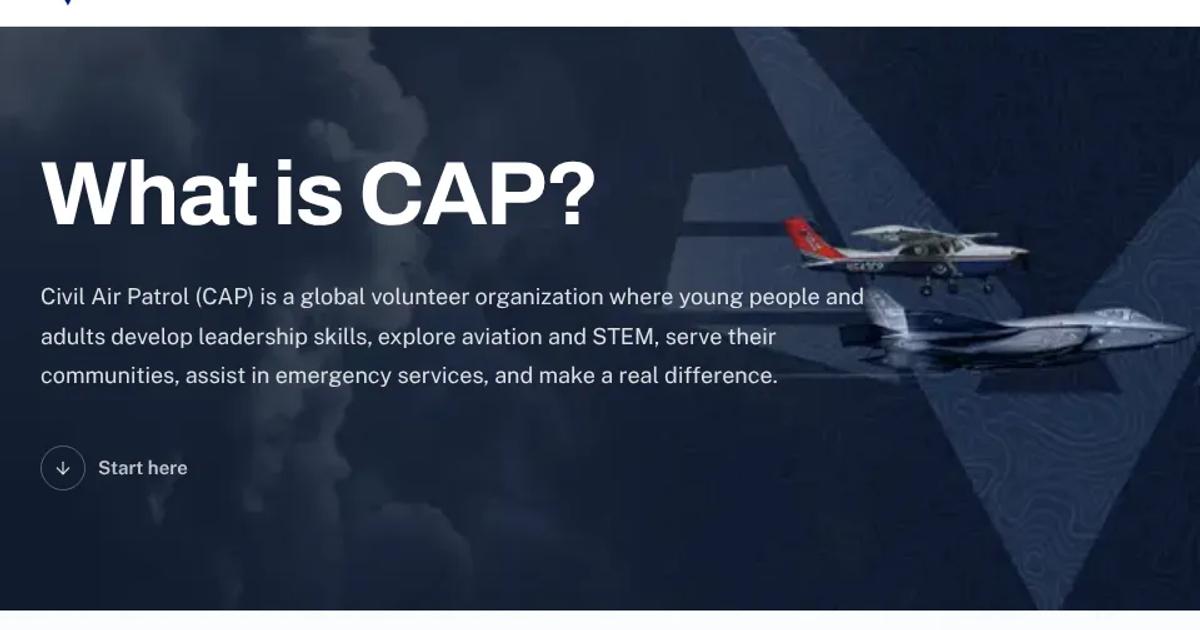
Civil Air Patrol members, who fly an average of 100,000 hours per year performing disaster relief, search and rescue, fighter intercept training, aerial reconnaissance, and cadet orientation flights, are indeed now referred to as Airmen during their performance of Air Force-assigned missions. Their legacy of selfless sacrifice and service to country and community continues daily through its core programs of emergency services, cadet programs, and aerospace education.
You too can be a part of the story. To learn more about membership and find your local unit, visit this “how to join” page.


