
Welcome to the Civil Air Patrol 85th Anniversary Series. Each week leading up to CAP’s milestone anniversary on Dec. 1, we will be highlighting key operations and developments in the organization’s history, as depicted in this newly designed “Be a Part of the Story” historical timeline:

This is the sixth feature of the series based on this tile included in the timeline: “Eyes of the Home Skies, Part 2: Civil Air Patrol’s Historic 9/11 Response.”
Sept. 11, 2001, broke crystal blue and golden on New York City’s Manhattan Island, like a heavenly late summer setting for a Hollywood romantic comedy.
Early that morning, Civil Air Patrol Col. Richard Greenhut, then the new Northeast Region commander for CAP, walked out of his apartment to the street.
He was two weeks on the job.
“I was thinking it was golden, it was gorgeous. It was crisp,” he said. “The sky was deep blue and I find, even all these years later, when I see a gorgeous fall day like that, I make the connection to [9/11] in my mind.”
On that fateful day, just before work began for stock traders, shopkeepers, cabbies, and commuters, hell broke loose. From Greenhut’s apartment to the White House to the headquarters of First Air Force and beyond, it was the young 21st century’s first day of infamy.
“When I heard about it, I immediately went downstairs to my street,” he said. From that high vantage point, he could see the top 25 to 30 floors of the Twin Towers. Pillars of smoke billowed from the stricken buildings, nearly four miles as the crow flies, from his apartment on the Upper West Side.
“I was standing there looking when the second airplane hit the South Tower,” he recalled.
Two hijacked commercial airliners plowed into the Twin Towers of the World Trade Center. A third pirated plane slammed into the Pentagon.
A fourth jetliner that terrorists aimed at 1600 Pennsylvania Avenue, was diverted thanks to the courage of passengers and crew — including a former CAP cadet, airlines Capt. Jason Dahl — a pilot who along with passengers stormed the cockpit of United Flight 93. The plane crashed in the Shanksville, Pennsylvania countryside. Some 44 perished there, but more lives were saved due to their bravery.

This historic aerial photo showing the smoldering remains of the World Trade Center on Sept. 12, 2001, is one of the earliest images taken by a CAP aircrew following the 9/11 terrorist attacks. The Pentagon-approved photo mission provided FEMA executives as well as President George W. Bush with situational awareness of the scene at Ground Zero. (Source: CAP National Headquarters)

During the same flight, the CAP aircrew captured this panoramic view of Lower Manhattan with the billowing smoke coming from what was the Twin Towers of the World Trade Center. (Source: CAP National Headquarters)
The world — and Civil Air Patrol — were forever changed. A CAP aircraft was one of the few civilian planes cleared to fly in American airspace in the immediate aftermath of the attack. For the U.S. Air Force auxiliary, the attacks of that day would usher in a new era of homeland security for CAP and transform its role in national defense.
Within minutes of the attack, Greenhut dispatched CAP aircraft. Soon after, with telecommunications crippled in New York, Greenhut moved CAP command and control to Massachusetts into a FEMA (Federal Emergency Management Agency) Cold War-era bomb shelter. From there, they were in direct communications with North American Aerospace Defense Command (NORAD) via a secure line.

A subsequent CAP flight over Ground Zero days later provided this view from above. The aerial photo and others from the site supported recovery efforts on the ground for months to come. (Source: CAP National Headquarters)
New Membership, a New Mission
Just as in the immediate aftermath of the 1941 Japanese attack on Pearl Harbor, Civil Air Patrol membership grew by some 10 percent over the two years following 9/11. The attacks also led to a change in the livery of CAP aircraft — to the signature red, white, and blue of today’s fleet.
To compare the terrorist attack by forces without a capital or flag to Pearl Harbor would be misleading. However, Greenhut said, the events of that day were another step in CAP officially becoming part of America’s Total Force in 2015.
“After 9/11, there was a renewed interest on the part of the Air Force to see what kind of role CAP could play in prosecuting noncombat missions.”
Several CAP wings in the Northeast flew missions in the region, joining Air Force fighters in exercises bearing names like “Fertile Angel,” and “Fertile Spade,” Greenhut said.
In those drills, member-owned and flown, twin-engine aircraft flew practice tracks well offshore, providing practice for the fighters.
These missions were a precursor to the “Falcon Virgo” and “Fertile Keynote” missions flown even today in the nation’s capital and other locations throughout the country, where CAP aircraft are intercepted by military assets in predetermined exercises. These civilian missions in air defense of the homeland were the first since World War II.

Members of the Civil Air Patrol aircrew that flew on Sept. 12, 2001, were (from left) then-Capt. Andrew Feldman, Lt. Col. Jacques J. Heinrich, and then-Capt. Warren Ratis. Heinrich piloted the plane, “44 Lima,” and remains a member of CAP. Both Ratis and Feldman, who took photos during the flight, later became CAP lieutenant colonels. (Source: CAP National Headquarters)
CAP Flight 3131, Heinrich, Ratis, and Feldman
When the crew of CAP Flight 3131 — Jacques J. Heinrich, Warren Ratis, and Andrew Feldman — took to the skies above Ground Zero on Sept. 12, 2001, they earned a place in history as the first civilian aircraft permitted to fly in American airspace after the attacks.
According to a 2021 story in CAP’s VOLUNTEER magazine, the plane was allowed to make three passes above the area — then a designated war zone — at an altitude of 1,300-2,000 feet.
“The memories of 9/11 still haunt me,” Ratis told Lt. Col. Steven Solomon in the article. “It had to be played out using the best of my knowledge, plus the inputs of the entire team that helped out in supporting this mission.”
“The thoughts are as fresh today as they were then. The mission briefings, both before and after completion, were quite thorough and memorable. The photos that were taken matched the views that my eyes saw. The feelings and sadness have made this a permanent etching in my mind.”
But a routine aerial photography mission might have turned into something more. A New York Police Department helicopter, unaware of the plane’s federal clearance, warned the crew to vacate the area.
The CAP aircrew, in equally strong terms, informed NYPD that it was on an Air Force-assigned mission for the Federal Emergency Management Agency and intended to complete it. Air traffic personnel at Kennedy International informed NYPD of the same, and the police chopper backed off. The CAP flight was accomplished with an assist from an Air Force F-15 escort.
The crew’s Cessna 172 — best known in CAP by its callsign nickname, “44 Lima” — is on display today at the National Museum of the U.S. Air Force in Ohio.

The 9/11 Civil Air Patrol Recognition Ceremony at Wright-Patterson Air Force Base near Dayton, Ohio, in 2024 preserved ““44 Lima” at the National Museum of the U.S. Air Force. The Cessna 172 Skyhawk is one of three CAP planes now on display at the museum. Two World War II-era aircrafts — a Fairchild Model 24-C8F and a Piper J-3C-65-8V (Original Piper Cub) — are also enshrined there. (Source: CAP National Headquarters)

Lt. Cols. Andrew Feldman (left) and Warran Ratis, who attended the museum ceremony in 2024, pose beside the CAP aircraft they used to capture the first aerial images over Ground Zero following the Sept. 11 terrorist attacks. Both Feldman and Ratis, longtime members of CAP, died earlier this year. (Source: CAP National Headquarters)
He Saw It Coming
CAP Lt. Col. Bob Ditch also bears the scars of 9/11. At that time, he was a colonel in the Air Force and local volunteer firefighter/paramedic, serving in a joint terrorism response unit, and became the then Department of Defense liaison at Ground Zero.
The debris in the air around Ground Zero, he said, caused him years later to get pulmonary issues, kidney cancer, as well as lingering vision problems from hazardous dust. While the overwhelming majority of Americans were shocked by the attacks, Ditch and others saw it coming.
Upon arrival at the rubble that day his reaction [still] surprised him.
“It was like — I hate to put it in these terms — but it was time to go to work. It was business as usual for me. For years I had witnessed so many catastrophic events from combat and many disasters. It was business as usual. … When I arrived, I was always amazed that I didn’t have any other emotions other than, ‘Let’s get to work.’ That’s how I had trained and prepared for what I knew would eventually arrive and, as a result, how I felt then.”
But years later, Ditch reflected on the tragedy that directly claimed nearly 3,000 souls and some 8,000 due to health issues related to the attacks. Countless more are still battling those illnesses.
“It took over 20 years to be ready to return to the site of 9/11 in Lower Manhattan,” he said. “Only then, the buried emotions came rushing back — you never forget.”
Ditch recalls the sights and sounds of what was known as “The Pile.”
He remembers the remainder of the buildings at the site groaning and swaying, sounds he described as “the most unsettling thing.
“The gut-wrenching sounds of twisted metal and concrete [are] a memory I will never forget,” he wrote later in his reflections on the events before and after 9/11. “Whenever the sounds broke through the ongoing noise at the scene, everyone stopped and looked at the buildings in quiet study, to see which one was strained and about to come down on their own on the workers. When the risk was more apparent, and possibility of secondary collapses became imminent, the sirens and horns would go off, and everyone would dash to take cover.”
And he also remembers the thick New York accent of one of the workers in the mountain of debris as he watched Air Force F-15s periodically soar overhead.
“Everyone started cheering,” Ditch wrote. “One worker I remember, took off his hard hat, and waved at the fighters, yelling in a very crusty New York accent, ‘That’s what I am [expletive, expletive] talking about.”
The terrorists who struck that September day ignited America’s longest war in Iraq and Afghanistan.
Ditch, only two weeks before the attack, had warned of a similar event while presenting at the Army War College counterterrorism symposium. He had been teaching for over a decade terrorism planning and response to the American military and first responders across the globe, from Somalia, Saudi Arabia, and here at home.
The major change wrought by the attacks, he believes, is that they turned America’s focus on endemic internal threats, not solely on the Cold War-era thinking on external enemies.
A Surreal, Lingering Memory
Every New Yorker — in fact every American — has a memory of 9/11. Region Commander Greenhut, who at the time had lived in the city for a quarter century, saw the terrible events unfold in real time.
“I’ll be frank with you,” he said. “While it was happening, I was kind of in denial about the sort of shock that it created. One of the things that struck me … to have those buildings missing from the skyline, was like when you were a kid and you lost a front tooth. You were constantly aware that something was missing, that there was a hole, that things weren’t normal, that things weren’t how they used to be.”
A Chaplain’s Impact
The Civil Air Patrol Northeast region chaplain, Father George Kelly, made a difference, helping Greenhut and others working during the 9/11 response deal with the trauma of the attacks. Kelly, a CAP lieutenant colonel, also served as a chaplain for the Veterans Administration.
The Catholic priest was trained in critical incident stress management.
“Father Kelly saw signs of [denial] in those of us who were working diligently on mitigation and made sure we were in touch with what was going on and not in denial,” Greenhut said.
‘A Sense of Violation’
For Greenhut and his CAP comrades there was also something deeper in the attacks.
“I found there was sort of a sense of violation,” Greenhut said. “[It was] ‘How dare you attack us in such a cowardly way.’ There was a great deal of that and it’s not unhealthy. It’s only unhealthy if you deny it, or you don’t examine it. It gave me license to understand that when something that traumatic occurs, it’s OK to feel angry. It’s OK to feel violated. It’s OK to have all those natural feelings.
“I don’t want to get all touchy-feely about it,” he said. “But the people who end up with real trauma are the ones who aren’t willing to deal with it.”
A Change in Perspective
The horrific events of that sun-splashed day in 2001 helped change how CAP was viewed by the Air Force.
“The thing that really changed was the Air Force’s appreciation for those missions we could prosecute that we could do at a fraction of the cost of their overhead,” Greenhut said.
A shining example was a mission Greenhut participated in for CAP in mid-October 2026 in the nation’s capital, known as Falcon Virgo, a part of NORAD’s Operation Noble Eagle. It was, like Sept. 11, a golden day awash in sunlight. “It was a gorgeous day to fly,” he said.
“We go up and we act as ‘tracks of interest’ for the interceptors. We get intercepted by F-16s. We get intercepted by Coast Guard helicopters. … It’s pretty awesome to be in Washington, D.C., in the nation’s most restricted airspace, flying around doing this kind of thing. Those missions would have been unimaginable before 9/11 because it just wasn’t something the Air Force considered us an asset for. Now it goes without saying.”
He added, “We can replicate the most common likely incursion that would happen in the D.C. area in the kind of aircraft most likely to do that. And we can do it in real time … in a safe and professional manner.”
Such exercises also augment the ground training for the National Capitol Region Joint Air Operations Defense Center. That same work continues nationwide.
“It’s an enormous amount of training for the people on the ground as well as the people in the air. And it’s a great mission for CAP. Part of it is a direct result of [the terrorist attacks], because this kind of an incursion — unheard of before 9/11 — is now something that has to be in the planning scenario.”
The exercises, Greenhut said, “are really good for both organizations.”

U.S. Air Force F-35s chase a CAP aircraft acting as a “target of interest” in advance of Super Bowl LX, held Feb. 8, 2026, in Santa Clara, California. The exercise was part of NORAD’s ongoing national air defense mission that began after 9/11. (Air Force photo)

In the same aircraft intercept exercise, an Air Force fighter escorts the CAP aircraft out of the airspace near Levi’s Stadium, reinforcing the importance of temporary flight restrictions (TFR) compliance and the integrated efforts used annually to safeguard the airspace in and around the Super Bowl. (Air Force photo)
For Ditch, who has been involved in terrorism and natural disaster and terrorism response since the 1980s, the Air Force view of CAP has changed due to 9/11 and the nation’s turn to internal threats, like terrorist attacks and major natural disasters like 2005’s Hurricane Katrina.
In an eerie aside, for years Ditch taught and published terrorism planning and response courses for the National Fire Academy and the Air Force/Department of Defense.
Long before that horrific day in 2001, all the terrorism student manuals had the same rendition on the cover. “It showed the New York City skyline with an explosion and the Twin Towers in a target’s bullseye,” he said. “It was so eerie to look at those covers after the 9/11 attacks.”
More haunting was in the introduction of the Air Force’s 1999 Terrorism Awareness Course written by Ditch. “The publishers took the liberty of inserting an animation of the New York City skyline with an explosion happening from out of one of the Twin Towers,” he said.
Both publications came out two years before 9/11.
Like Greenhut, Ditch agrees that the Air Force perspective and acknowledgement of CAP was transformed by 9/11 and the homeland security and presidential directives that followed. Notable was the passing of Homeland Security Presidential Directive 5, which CAP immediately embraced in its command-and-control transformation and compliance to the presidentially directed Incident Command System and National Incident Management System, still evolving today through CAP.
“It took 9/11 and Hurricanes Katrina and Rita to have the United States look within,” Ditch said. “And when it looked within, it discovered this new world that had always been there called ‘First Response, and the fact that all disasters are local,’ followed by [a need for] ‘Homeland Security.’ Anything attached to that became more acknowledged. We had to first ensure that the ‘Hometown’ was secure before we could have genuine ‘Homeland Security’ and CAP was already there making it so.”
“So, Civil Air Patrol finally became acknowledged by its parents, the United States Air Force. Civil Air Patrol had only been an ornament for them until 9/11 and Katrina, at which time, [CAP] became the tip of the spear.”
Be a Part of the Story
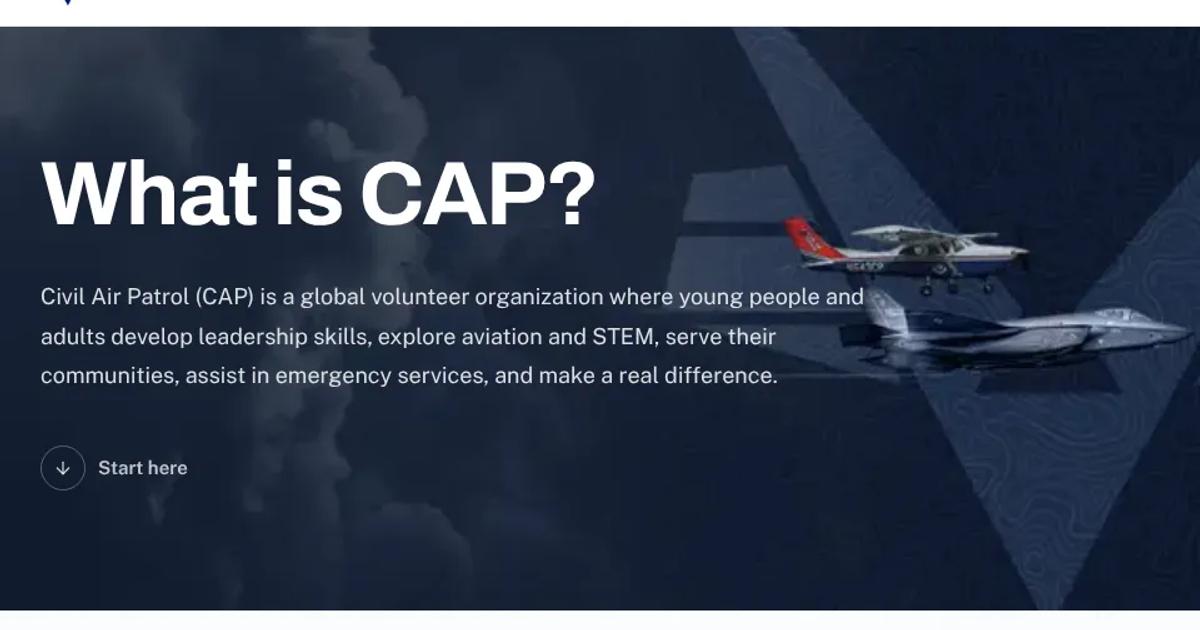
Find your place in Civil Air Patrol just as thousands of Americans did in the aftermath of the 9/11 terrorist attacks.
Whether you’re a teen seeking adventure, an adult looking to serve, or an educator seeking powerful STEM resources, there’s a place for you in CAP.
To learn more about membership and find your local unit, visit this “how to join” page.


