
Military bases around the country have been subject to frequent incursions by uncrewed aircraft systems (UAS), otherwise known as drones. Civil Air Patrol (CAP) is helping the U.S. Air Force (USAF) train for its growing mission to detect unauthorized drone flights and quickly locate the offending operators.
A case in point is a recent training and evaluation mission in South Dakota. Members of CAP’s South Dakota Wing flew 10 drone flights for the South Dakota Air National Guard 114th Fighter Wing as part of a larger Combat Readiness Inspection.
“The ability to execute the mission under increasing drone threats is an important skill tested during the CRI. Realistic scenarios allowed us to pressure test competence in both simple and complex tasks while dealing with this modern battlefield threat.”

Maj. Tyler Gross, an FAA-licensed commercial drone pilot with the Civil Air Patrol’s South Dakota Wing, prepares a UAS during Operation EDGECRUSHER, a Combat Readiness Inspection near Joe Foss Field in Sioux Falls, South Dakota. The outside-agency support provided a realistic training opportunity for the 114th Fighter Wing to evaluate coordination, communication and response procedures during simulated unmanned aircraft activity near the installation. (U.S. Air National Guard photo by Master Sgt. Luke Olson)
CAP: A Total Force Partner
This training directly aligns with U.S. Northern Command’s priority of defending the homeland. As the combatant command responsible for theater security,
USNORTHCOM maintains a joint focus on securing military installations and critical infrastructure across its Area of Responsibility against evolving asymmetric threats, including unauthorized UAS activity.
Some drone flights in restricted airspace near U.S. military bases are by hobbyists unaware of the restrictions or not intending harm, but across the country some have been by drug cartels and foreign agents. In Ukraine, similar drones have been used as offensive weapons.
“As the volunteer auxiliary of the Air Force, CAP is part of the Air Force Total Force. We were pleased to accept the request to support this drone training because it is a new category of how South Dakota CAP members can support the Air Guard, this time with our small uncrewed aircraft systems.”
This collaboration is operationally overseen by First Air Force (Air Forces Northern), which manages Civil Air Patrol’s federal auxiliary missions in support of homeland defense.

A South Dakota Wing UAS works on a training sortie in the rugged terrain of the Black Hills. Photo by Col. Michael Marek, South Dakota Wing

CAP drone pilots Maj. Tyler Gross, left, and 1st Lt. Travis Robinson debrief following the simulated UAS scenario during Operation EDGECRUSHER. The scenario gave Airmen a realistic opportunity to practice coordination and response procedures with local mission partners. (U.S. Air National Guard photo by Master Sgt. Luke Olson)
Testing Base Security
The weeklong Combat Readiness Inspection tested the fighter wing’s ability to shift from normal operations to a wartime posture in many areas, including the drone response, while generating, defending, and sustaining combat airpower in what is called a contested and degraded environment. The CAP support provided a realistic training opportunity for the 114th Fighter Wing to evaluate coordination, communication, and response procedures during simulated unmanned aircraft activity near the installation. For operational security reasons, this article does not detail the 114th Fighter Wing’s counter-UAS response procedures or capabilities.
“The drone training provided by CAP during the 114th Fighter Wing’s Combat Readiness Inspection is a logical step to deepen the relationship and provide training focused on entire base defense, not just training for the fighter squadron. This also presents the very real asymmetric threat that the U.S. military faces across the globe.”
Civil Air Patrol was an early user of the now-common small remote-piloted photography drones. The South Dakota Wing used the then-new technology to perform CAP’s first actual missing person search and rescue drone flights in September 2019. CAP in Nebraska used a UAS system in a disaster relief mission to inspect a damaged dam that same year.
The wing has also used photography drones for partner agencies, such as wildlife tracking for the South Dakota Game, Fish, and Parks agency. For the South Dakota School of Mines and Technology, CAP used Wingtra drones to collect and process over 786,000 multispectral images for environmental research.
That extensive experience made CAP a preferred partner for simulating airspace incursions.
“I found the Air Guard mission I participated in unique and exciting,” said Capt. Kurt Johnson, a CAP drone technician during the training. “First, launching a drone over a National Guard base and knowing that within minutes, the base is responding to our simulated threat was a great feeling. Although everything included the caveat ‘exercise, exercise,’ it was exciting to have been a part of this.”
Maj. Tyler Gross, one of the drone pilots for the CAP support mission, agreed.
“It was fulfilling to combine my passion for drone flying with an opportunity to provide our Air Guard partners with realistic training scenarios in the rapidly evolving world of unmanned aerial systems,” he said. “This is just one of the many unique opportunities CAP membership has afforded me; doing the things I love while helping my community.”

South Dakota Wing’s Skydio X10D UAS sits on the landing and take-off pad used for safe operations. Photo by Col. Michael Marek, South Dakota Wing

UAS pilot Maj. Donny Weiand supervises the automatic landing of the CAP Skydio X10D, which had been used to map a hiking trail to look for a simulated missing hiker. The drone took hundreds of photos on a pre-programmed course, including visible light and infrared. Photo by Col. Michael Marek, South Dakota Wing
Rich Opportunities for CAP Members
Civil Air Patrol members have diverse opportunities to serve national, state, local, and in some areas, tribal agency partners. CAP in South Dakota has a long partnership with the 114th Fighter Wing, including CAP airplanes serving as targets for F16 intercept training and surveying air guard low-level training routes.
CAP across the country performs similar air guard support missions, as well as for active-duty military bases. CAP in South Dakota alone has worked with the Bureau of Indian Affairs on missing person searches, with the Global Strike Command for damage assessment after a crash, and escorting Air Force MQ-9 remote-piloted drones through civilian airspace, as required by the FAA.
“Being a member of Civil Air Patrol is about service. In addition to directly supporting non-combatant Air Force missions, CAP has responsibilities that are part of the USAF’s support to civil authorities to save lives, relieve suffering, prevent property damage, and provide humanitarian assistance. It’s rewarding to work with these agency partners as volunteers serving America’s communities, saving lives, and shaping futures.”
You Can Serve Too
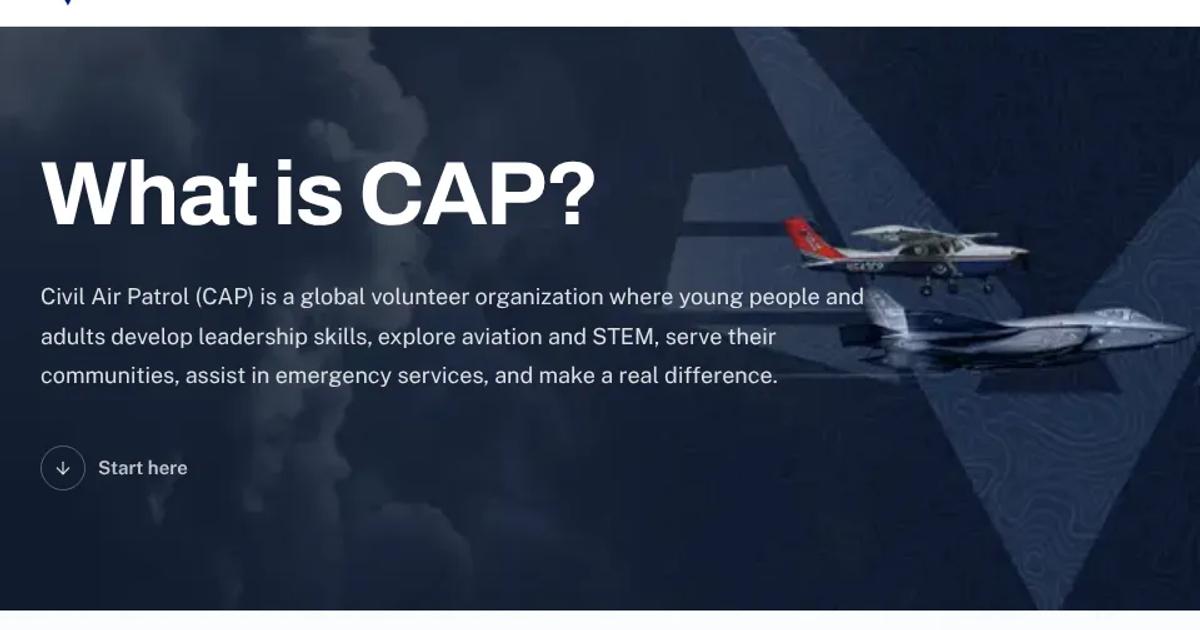
Civil Air Patrol offers broad experience for both its adult and youth members. Young people from ages 12-20 have the opportunity to learn more about aviation, cyber, STEM and military careers while enhancing their leadership skills. Adult members work with day-to-day operations in their local units. Fewer than one-fifth of all CAP members are pilots or aircrew members. In emergency services and operations, adult and youth members may help with search missions, communications, taking photos, or transportation of relief supplies.
Adult members have the opportunity to help in all aspects of the youth program, providing the opportunity to have a positive influence in the lives of young people.
With more than 1,400 squadrons nationwide, a cadet corps of over 36,000, about 35,000 adult members, and more than 1,400 local units in all 50 states, the District of Columbia, Puerto Rico/Virgin Islands, and overseas American military bases, there’s a CAP opportunity near you.
To learn more about membership and find your local unit, visit this “how to join” page.


