Welcome to the Civil Air Patrol 85th Anniversary Series. Each week leading up to CAP’s milestone anniversary on Dec. 1, we will be highlighting key operations and developments in the organization’s history, as depicted in this newly designed “Be a Part of the Story” historical timeline:

This is the fifth feature of the series based on this seventh tile included in the timeline: “How Civil Air Patrol Became a National Disaster Response Force.”
Hurricane Hugo came ashore at Sullivan’s Island, South Carolina, just before midnight on Sept. 21, 1989, as a Category 4 storm that drove a 12- to 14-foot wall of water into the coastline and left the region without power, water, or easy access for weeks. The Federal Emergency Management Agency (FEMA) turned to Civil Air Patrol for support, alongside Hurricane Andew three years later, Hurricane Floyd in 1999, and the aftermath of the Exxon Valdez oil spill in Alaska.
What made all of it possible wasn’t luck. It was, at that point, years of quiet, deliberate work building a volunteer-led organization that could show up quickly, communicate clearly, and fly wherever the next disaster happened to strike.

This aerial photo taken from one of Civil Air Patrol’s signature red, white, and blue planes shows ongoing oil containment efforts in the Gulf of Mexico in 2010. Millions of gallons of oil leaked from BP’s Deepwater Horizon drilling rig following an explosion on April 20. During the four-month mission that followed, CAP aircrews launched more than 1,000 flights, logging nearly 2,500 hours in support of the oil spill recovery response. (Source: CAP National Headquarters)
A New Kind of Command
Such work started with a change most Americans never noticed. In 1975, Civil Air Patrol put a volunteer in charge for the first time in its 34-year history. Since 1941, CAP’s national commander had always been an active-duty Air Force officer appointed from outside the organization. That year, the job went instead to one of CAP’s own.
It marked the moment CAP stopped simply carrying out missions handed down from above and started shaping its own future. Volunteers who’d spent decades flying search patterns were now deciding what came next.
That shift would echo for decades into the disaster response missions of today.
Richard L. Anderson, who completed a three-year term as CAP national commander in the mid-1990s and now serves as assistant secretary of the Air Force for manpower and reserve affairs, remembers pressing Air Force leadership during his own tenure to formally recognize CAP’s growing role.
“One of the things I have always said, but now I’m in a place where I can say it with meaning is that I have tried to transform our dialogue from 'active, Guard, Reserve' to 'active, Guard, Reserve and auxiliary.’”
A video address delivered by then-Air Force Chief of Staff Gen. Ronald R. Fogleman at CAP’s National Conference in 1995 seemed to verify Anderson’s beliefs — years before it became official policy.
“Today, you continue your proud service to the Air Force and the nation,” Fogleman said. “You are the only Air Force presence in hundreds of American communities — and I, for one, am proud for you to represent our Air Force. You are an invaluable member of the Air Force’s Total Force that consists of a mix of four diverse, yet inseparable, components: The Active Air Force, Air National Guard, Air Force Reserve, and the Air Force Auxiliary.”
“For that reason,” Anderson said, “I have always considered that point in time to be when CAP was unquestionably a member of the Total Force.”

A Florida Wing photographer works from the back seat of a CAP aircraft over Sanibel Island in 2022. The mission scanner’s digital images helped assess the damage wrought by Hurricane Ian, which decimated the island off the coast of Fort Myers, Fla. (Source: CAP National Headquarters)

During Hurricane Helene relief operations in 2024, a CAP aircrew from the North Carolina Wing spotted a hand-drawn “SOS” distress message on a washed-out, damaged stretch of road in Burnsville. The aircrew was able to send help to area residents who were stranded by the floodwaters caused by the storm. (Source: CAP National Headquarters)
Building the Toolkit
In 1979, CAP began flying Military Training Route surveys for the Strategic Air Command and Tactical Air Command, a new kind of technical mission that put CAP aircrews to work supporting the Air Force’s own training pipeline. In 1985, an agreement with the U.S. Customs Service added counterdrug reconnaissance to CAP’s portfolio, with volunteer pilots helping law enforcement track smuggling routes from the air.
That same year, Congress passed what became known as the CAP Supply Bill, authorizing direct federal funding and procurement for the organization through the Air Force.
CAP also resumed a mission it had flown decades earlier: delivering cargo for the Air Force — now including human tissue and organ transplants for the American Red Cross, often on short notice.
By 1995, CAP had built out its own professional headquarters staff to run day-to-day operations, with the Air Force stepping back into an advisory role. The volunteers who had gained command in 1975 now had the infrastructure to match.
Tools to respond to disasters also were changing. GPS navigation replaced dead-reckoning guesswork. Internet-based communications and handheld two-way radios let CAP ground teams and aircrews coordinate with federal authorities in ways that simply hadn’t been possible before. By the end of the century, CAP operated its own fleet of hundreds of aircraft and vehicles instead of a scattered collection of member-owned planes.
FEMA called on those resources throughout the 1980s and 1990s in response to disasters like hurricanes and the 1995 Oklahoma City bombing. Each mission tested a little more of what the newly modernized CAP could do.

This CAP aerial photo of the Louisiana Superdome in New Orleans shows roof damage in the wake of Hurricane Katrina in 2005. The indoor stadium was used as a "shelter of last resort" for about 10,000 residents in the city unable to evacuate before the storm’s Aug. 29 arrival on the Mississippi Gulf Coast. (Source: CAP National Headquarters)

Levee failures in New Orleans the morning after Katrina made landfall caused heavy flooding in many of the city’s neighborhoods, including this one located next to one of its canals. (Source: CAP National Headquarters)
CAP also got ahead of a change most emergency agencies wouldn’t adopt for another decade. “CAP actually started to transition to the Incident Command System in the 1990s ahead of the mandates after 9/11,” said John Desmarais, a recent CAP chief operating officer and director of operations, “and that gave us strong standing in the professional emergency management and public safety arena.” As he put it, “Good work presented more opportunities for more good work.”
That foundation was tested at a scale no one planned for when Hurricane Katrina struck the Gulf Coast in August 2005. More than 1,800 CAP members from 17 wings mobilized, logging some 50,000 volunteer hours and flying more than 1,000 sorties in support of search, rescue, and damage-assessment missions. It remains one of the largest disaster responses in CAP’s history, with the GPS navigation, modern communications, and standing fleet drawn from a toolkit built over the previous two decades — ready when it mattered most.
Katrina just didn’t test the toolkit. It changed the rules governing how it could be used.
“That changed a lot of how response is done across the country, not just us, but everybody.”
Before Katrina, Lahan explained, responders had to wait for a disaster to strike — and a governor to formally request help — before moving resources into place. “After that, they changed the law, and they’re like, no, we can pre-position stuff, and then if it’s needed, we can move in,” he said.
Today, FEMA’s “surge funding” lets CAP, tasked through the Air Force, stage people and equipment ahead of landfall, rather than after it.

This high-resolution image from a video made by a CAP aircrew scanner in 2018 shows the catastrophic damage wrought by Hurricane Michael in the Florida Panhandle. (Source: CAP National Headquarters)
A Decade Later, Official Recognition
Ten years after Hurricane Katrina and 20 years after the National Conference in 1995, CAP earned something it had never formally held: a place in the U.S. Air Force’s Total Force. On Aug. 28, 2015, the Air Force officially expanded its definition of “Total Force” and “Airmen” to include CAP’s civilian and auxiliary members alongside the Air Force, Guard, and Reserve.
Anderson, who’d pushed for that designation two decades earlier, saw it as the product of accumulated trust in CAP and likened the announcement in 2015 to a cross-country, connecting airline flight. “The journey for CAP was in fact a flight that consisted of two legs: The first flown in 1995 and the second flown in 2015,” he said.
Anderson puts a number on what that trust is worth today: roughly $280 million in value delivered annually by CAP’s all-volunteer force, which amounts to a fraction of military aircraft operating costs. What the Air Force truly can’t replicate, he added, is CAP’s reach. “The Civil Air Patrol footprint extends all across the country, into virtually every nook and cranny,” including communities with no other Air Force presence at all.
It echoed, in its way, the Congressional Gold Medal awarded to CAP for its World War II volunteers’ service seven decades later. But where the Gold Medal honored a single wartime chapter, Total Force status recognized something else: 40 years of methodically building a resource the nation could count on, disaster after disaster.

When conditions limit traditional aircraft, CAP drones can help fill the gap. Here, a small uncrewed aircraft system (sUAS) photo shows boats scattered across a hurricane‐damaged San Carlos Island marina. The aerial photo was taken in the wake of Hurricane Ian, which slammed into the southwest Florida coastline in 2022. (Source: CAP National Headquarters)
Looking Ahead
The disaster response toolkit keeps evolving. CAP now flies pod-mounted, GPS-linked camera systems that can survey storm damage across huge areas in hours rather than weeks, Lahan said. Drones have become essential where crewed aircraft can’t fly. During recent Washington wildfires, thick smoke grounded fixed-wing planes, but drones flew underneath it.
Starlink will soon let aircraft stream live video directly to emergency command centers regardless of ground infrastructure. And where CAP once relied on whatever aircraft individual members happened to own, it now operates a standardized, corporate-owned fleet any qualified pilot can fly.
Artificial intelligence is already part of the picture, too. “We already use it to some degree, like when we’re doing the damage assessment,” Lahan said, to help sort and prioritize what needs human eyes first.
Desmarais expects that to deepen, given imagery collection has moved from film to slow-scan to digital to hyperspectral sensors over three decades. “I think CAP will likely be collecting more imagery of varied types and will soon truly get to near real-time dissemination.”
Nowhere is that shift clearer than in CAP’s Geospatial Program, founded in 2019 and now drawing on more than 2,600 volunteers. When wildfires tore through Lahaina and Kula on Maui in August 2023, a small CAP-FEMA team had already remotely identified hundreds of damaged structures before most of the world knew the disaster’s scale, ultimately assessing some 2,000 homes and businesses and finding more than 1,800 destroyed or damaged.
President Joe Biden used the team’s map in issuing a federal disaster declaration. “In his hand he was holding a map — and it was our team’s map,” said Maj. Scott Kaplan, who directs the program, in a published report.
“We never thought the products our team helped FEMA create would be given to the president.”

Imagery like this taken with a specialized CAP camera pod provides a multi-spectral view of the ground, resulting in 360-degree, 3D images of a neighborhood affected by Hurricane Laura in Louisiana in 2021. Such imagery can be reviewed from all angles in assessing damage and generating estimates for debris collection. (Source: CAP National Headquarters)
Some of CAP’s disaster-response history runs quieter than hurricanes and wildfires. Nearly 50 years ago, CAP began flying blood from Red Cross centers to rural Kansas hospitals — a response to a simple problem: most counties there have only one hospital, with no way to borrow blood from a neighbor.
“Nobody knows how it started,” Lahan admitted, “because I’ve gone down that route, tried to find that out.” What’s certain is that it’s still running, even if the ratio has flipped — once roughly 90% flown, now 90% driven, with flights reserved for cases the Red Cross and Air Force deem genuinely life-critical.
That mission runs separately from CAP’s newest lifesaving effort, Operation Pulse Lift, born out of pandemic-era blood shortages. Volunteers now support donation drives and process blood through the Armed Forces Blood System in 22 U.S. states/territories and Japan. Recently, on one day, members in the New Jersey, Texas, and California wings processed 1,424 units at Joint Base McGuire-Dix-Lakehurst, Joint Base San Antonio, and Travis Air Force Base for overseas military medical operations.
According to Desmarais, the program has expanded blood donation and transport capacity by 42%, now helping save over 60,000 additional lives annually. Lt. Col. Bob Ditch, director of the program, says the mission over the last 6½ years has collected/processed enough blood to potentially save up to 375,000 lives.
Different missions, same instinct: find where a community has a gap nobody else is filling, and fill it. “There’s always disasters, there’s always stuff going on,” Lahan said. “People are still going to need help ... These are the kind of things you should be looking at.”
The tools will keep changing. As he put it, disaster response “isn’t going away — it’s just the tools we use to accomplish it will change, and it’s always going to require people to use those tools and then be in the field doing that work.”

Lt. Col. Kevin Webster and 1st Lt. Helena Gaither of the New Jersey Wing process blood units at the Armed Services Whole Blood Processing Lab at Joint Base McGuire-Dix-Lakehurst. CAP members in New Jersey, California, Texas, as well as in Okinawa, Japan, have processed thousands of units of blood this year for shipment to overseas military medical facilities. (Source: CAP National Headquarters)
Be a Part of the Story
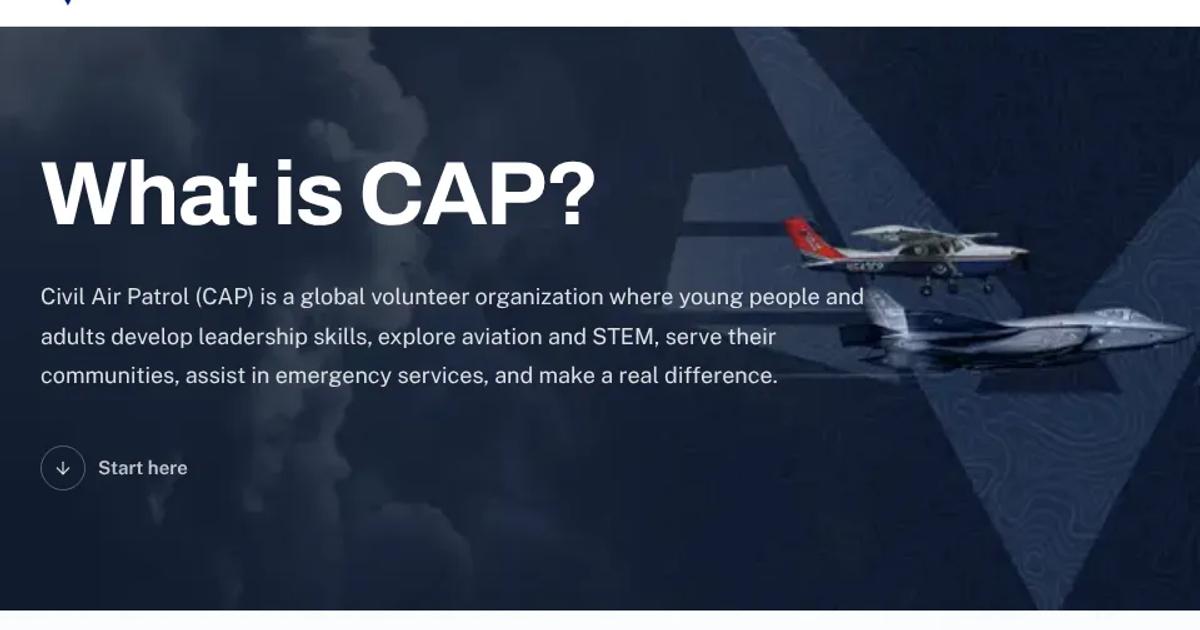
In Civil Air Patrol’s disaster relief and emergency services operations, adult and youth members may help with search missions, communications, taking photos, or transportation of relief supplies.
With more than 1,400 local units nationwide, there’s a CAP opportunity near you.
To learn more about membership and find your local unit, visit this “how to join” page.


